

When we look at the patterns of the Lord in Scripture, we begin to see a beautiful truth: He never asks for a sacrifice without intending to fill our hands in return.
His call to release what we hold dear is rarely a loss on our end; it is almost always an invitation to receive blessings tenfold.
Yet, knowing this doesn’t automatically make the act of letting go feel any easier, does it?
The process itself—the waiting, the uncertainty, the dealing with the unknown—can honestly be difficult.
When the cost feels too high, where do we turn?
Perhaps we can find inspiration in the story of the widow of Zarephath. Let’s learn from her lesson and find hope that there is a blessing in sacrificing.
The Story of The Widow Of Zarephath
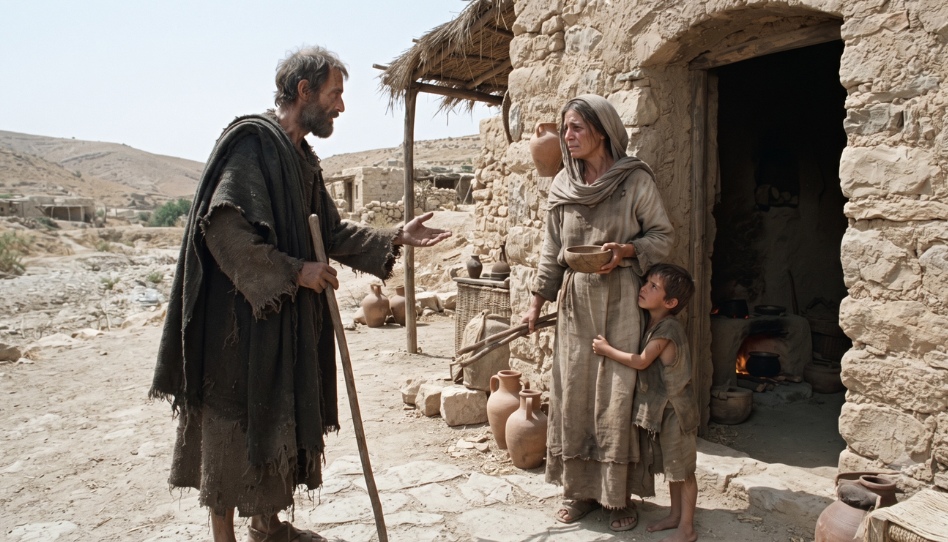
In the dusty, drought-stricken town of Zarephath, a widow faced the ultimate test of survival.
She was down to her final handful of flour and a little oil. With no more resources to spare, she was preparing her last meal before she and her son expected to face starvation.
And in that very moment, the Prophet Elijah came to her and asked her to make him “a little cake,” the very thing she was preparing to feed herself and her son.
She was honest about her poverty, saying, “As the Lord thy God liveth, I have not a cake, but an handful of meal in a barrel, and a little oil in a cruse” (1 Kings 17:12).
She acknowledged her scarcity plainly, yet when the Lord asks you to sacrifice, He is looking for the heart that obeys despite the lack.
By offering a sacrifice to the Lord, she chose to trust God’s word over her own empty pantry. It took immense faith to sacrifice to give away her last bit of sustenance, proving that even when it’s hard to follow the Lord, His timing is perfect and He has a reason.
How Her Life Was Blessed
The miracle that followed was a testament to her obedience. The scriptures record, “And the barrel of meal wasted not, neither did the cruse of oil fail, according to the word of the Lord” (1 Kings 17:16).
This is the tangible outcome of the Lord asking you to sacrifice—He takes what feels like a final, dwindling resource and transforms it into an endless supply. Even if – at the moment of sacrifice – you feel like you’re going to lose something extremely important.
By offering a sacrifice to the Lord, the widow saw her scarcity turned into an overflow that sustained her family for the duration of the drought.
Her experience proves this powerful truth to us: the faith to sacrifice invites a divine multiplication that transcends our earthly circumstances, especially when it’s hard to follow the Lord.
The Power Of How The Widow of Zarephath Responded
She did not hide her situation; she was transparent about her fear. She told Elijah, “I am gathering two sticks, that I may go in and dress it for me and my son, that we may eat it, and die” (1 Kings 17:12).
She was staring at death, yet when the Lord asks us to sacrifice, He often meets us in our most desperate hour.
By offering a sacrifice to the Lord, she moved past her logic and gave what she had. She demonstrated the faith to sacrifice because she listened to the prophet’s promise of provision, choosing to follow God even when it’s hard to follow the Lord.
How We Can Apply It In Our Life
Just like the widow, we may feel we have nothing left to give, yet the Lord asks you to sacrifice our limited resources and our deepest fears.
When you find yourself offering a sacrifice to the Lord, remember that He honors your honesty about your struggle. Build the faith to sacrifice by recognizing that God is the source, not your current circumstances, even when it’s hard to follow the Lord.
5 Steps In Dealing With The Struggle When The Lord Asks Us to Sacrifice
Be Honest About Your Scarcity
Like the widow, bring your “handful of meal” to the Lord in prayer. Trying to hide our lack from Him only creates distance, but transparency invites His power. The Lord asks you to sacrifice what you have, not what you don’t, and He values the courage it takes to admit we have nothing left to give.
President Russell M. Nelson reminds us, “The Lord loves effort, and effort brings rewards.”
You may be facing a professional or financial downturn and feel like you have no “seed” left to plant. Instead of performing for others, tell the Lord, “I am empty, and I am scared.” By offering a sacrifice to the Lord—not of money, but of your pride and honesty—you open the door for Him to provide. This is essential, especially when it’s hard to follow the Lord through seasons of lack. The faith to sacrifice begins the moment you stop pretending you have it all figured out.
Surrender Your Logic
When offering a sacrifice to the Lord, you may not see the path forward because His math rarely matches ours. Logic says, “If I give this away, I will have less.” Faith says, “If I give this away, I am making room for God’s ability to multiply what I have.”
Proverbs 3:5 tells us: “Trust in the Lord with all thine heart; and lean not unto thine own understanding.”
Perhaps you are prompted to give time to a church calling or a volunteer service when your calendar is already at a breaking point. Your logic screams that you need that time to rest or catch up on work. When the Lord asks you to sacrifice your time, choosing to obey anyway is an exercise in divine logic. You are demonstrating the faith to sacrifice your personal agenda, even when it’s hard to follow the Lord and your own common sense.
Act in Faith Despite the Fear
Developing the faith to sacrifice means obeying even while your hands are shaking. Obedience is not the absence of fear; it is the act of moving forward in spite of it. Elder Neal A. Maxwell taught, “The submission of one’s will is really the only uniquely personal thing we have to place on God’s altar.”
You feel a prompting to reconcile with a family member who hurt you deeply. The fear of being rejected again is paralyzing. When the Lord asks you to sacrifice your desire to be “right” or protected, doing it while feeling vulnerable is the ultimate offering. You are offering a sacrifice to the Lord that requires deep trust. Even when it’s hard to follow the Lord, your willingness to step into the unknown proves that your devotion is stronger than your anxiety.
Prioritize the Lord’s Instruction
Even when it’s hard to follow the Lord, put His requests first. As the widow gave to the prophet before feeding herself, we are often asked to place God’s priorities at the top of our list. This is the heart of “seeking first the kingdom of God.”
Let’s say you have a major project deadline, but you feel a strong impression to pause and support a friend in crisis. The Lord asks you to sacrifice your immediate productivity for His higher calling. By offering a sacrifice to the Lord—in this case, your time and your need for control—you are choosing His timing over your own. The faith to sacrifice often means doing the “God-thing” before the “good-thing.”
Watch for His Sustaining Grace
Keep a record of how He provides. As you see the “oil not failing” in your own life—the unexpected help, the sudden peace, or the resources that appeared when they shouldn’t have—your confidence will grow for the next time the Lord asks you to sacrifice.
Start a “Blessing Journal” where you note every time you were worried about a lack, you obeyed, and then saw God intervene. Maybe it was an unexpected check in the mail, or the perfect advice arriving just as you were about to give up. Each entry is a testament to the fact that offering a sacrifice to the Lord is a gateway to abundance. The faith to sacrifice becomes a natural reflex once you truly believe that God’s grace is sufficient, even when it’s hard to follow the Lord.
Our Faith To Sacrifice Will Bring Miracles
The widow’s story is a mirror for our own hearts: sacrifice is never about loss, but about making room for God’s abundance. We often wait for the miracle before we give, but the Lord invites us to offer our “handful of meal” first. When we obey to sacrifice, our faith increases and we see miracles.
Every act of surrender is a declaration that we trust the Provider more than our provisions. Your obedience is not a loss; it is the seed of a future harvest. Trust that He who sustained the widow will sustain you, too, and you will find Him faithful every time.